Latest Eye Care Procedures Using Advanced Technology
Ophthalmic medicine has entered an era of clinical precision driven by robotic guidance systems and high-frequency laser platforms. This article explores the Latest Eye Care Procedures Using Advanced Technology that are redefining how clinical interventions restore visual acuity and treat complex ocular diseases.
The modern medical landscape focuses on delivering superb patient outcomes through highly modern diagnostics and micro-surgical techniques. Understanding these complex clinical eye surgeries helps patients make informed decisions about their long-term vision health.
Latest Eye Care Procedures Using Advanced Technology in Vision Correction
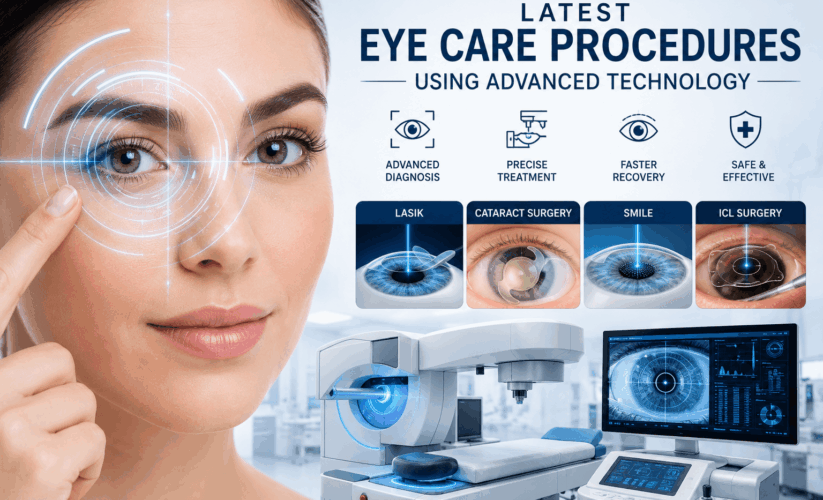
SMILE surgery represents the third generation of laser vision correction, following PRK and LASIK. It is incredibly precise. Surgeons employ a femtosecond laser to shape a thin, contact lens-like lenticule inside the intact cornea before extracting it through a tiny incision under four millimeters.
When considering the Latest Eye Care Procedures Using Advanced Technology, patients often learn about SMILE and Contoura Vision. This minimally invasive approach preserves corneal biomechanical stability and significantly reduces the incidence of post-operative dry eye syndrome. Patients typically reach visual recovery within twenty-four hours.
Contoura Vision guided LASIK represents another leap forward. This system maps twenty-two thousand unique elevation points on each cornea. The specialized software creates a highly customized ablation profile that addresses microscopic irregularities which standard glasses cannot correct.
- SMILE requires a microscopic incision, minimizing corneal nerve damage.
- Contoura Vision customizes treatment based on twenty-two thousand corneal elevation points.
- Visual recovery for both procedures typically occurs within one day.
Retinal Treatments and the Latest Eye Care Procedures Using Advanced Technology
In the past, retinal diseases often meant permanent blindness. Modern therapies have changed this completely. High-resolution optical coherence tomography angiography allows clinicians to map retinal microvasculature without dye injections, guiding precise laser therapy to halt disease progression.
Many of the Latest Eye Care Procedures Using Advanced Technology focus on the retina, where extreme precision is paramount. Gene therapy represents a massive shift for inherited retinal dystrophies. Voretigene neparvovec-rzyl, known commercially as Luxturna, delivers a functional copy of the RPE65 gene directly to retinal cells.
This single-dose subretinal injection restores functional vision in patients with confirmed genetic mutations. Intravitreal implants also offer sustained-release medication for chronic retinal conditions. These microscopic drug delivery systems release therapeutic agents over several months, reducing the frequency of clinic visits.
Patients experience stable drug levels without the sudden peaks and valleys of traditional eye drops. This steady delivery protects vulnerable ocular tissues from fluctuations.
- Optical coherence tomography angiography maps retinal blood vessels in seconds.
- Luxturna gene therapy delivers functional genes directly to damaged retinal cells.
- Sustained-release implants provide continuous therapeutic levels for months.
Latest Eye Care Procedures Using Advanced Technology for Glaucoma
Older glaucoma surgeries carried significant risks of hypotony and infection. Minimally Invasive Glaucoma Surgery has completely altered the treatment path for mild-to-moderate glaucoma cases. These microscopic procedures employ tiny stents to bypass clogged drainage pathways inside the eye.
The iStent inject W is currently one of the smallest medical implants approved for use in the human body. This device measures only three hundred and sixty micrometers. It creates two distinct entry points into Schlemm’s canal, facilitating immediate intraocular pressure reduction.
Selective Laser Trabeculoplasty serves as another primary intervention. This laser target-selectively treats pigmented trabecular meshwork cells without causing thermal damage to surrounding tissues. The procedure stimulates the body’s natural healing response to clear the drainage system.
- MIGS devices like the iStent measure under one millimeter in size.
- Selective Laser Trabeculoplasty lowers pressure without damaging thermal effects.
- These interventions reduce or eliminate the daily need for medicated eye drops.
Latest Eye Care Procedures Using Advanced Technology in Cataract Surgery
Femtosecond laser-assisted cataract surgery replaces manual incisions with computerized precision. The laser automates corneal incisions, capsulorhexis, and lens fragmentation. This automation reduces the amount of ultrasound energy required to remove the cloudy lens, protecting corneal health.
Intraoperative biometry systems like ORA provide real-time measurements of the eye during surgery. This system calculates the ideal intraocular lens power after the natural lens is removed. Surgeons make precise adjustments to astigmatism correction before finishing the procedure.
Advanced intraocular lenses offer patients freedom from corrective eyewear. Trifocal lenses provide clear vision at near, intermediate, and far distances. Extended depth of focus lenses provide a continuous range of high-quality vision with minimal glare.
| IOL Type | Target Distance Focus | Primary Benefit |
|---|---|---|
| Monofocal Lenses | Single distance (near or far) | Superb distance clarity but requires reading glasses |
| Trifocal Lenses | Near, intermediate, and far | Complete independence from spectacles for most tasks |
The Future Landscape of Ophthalmic Innovation
Artificial intelligence algorithms are now screening patients for diabetic retinopathy and macular degeneration with high accuracy. These systems inspect retinal scans in seconds, identifying microscopic lesions that might elude human detection. Early identification allows for immediate intervention and prevents vision loss.
Patients seeking the Latest Eye Care Procedures Using Advanced Technology should consult specialized ophthalmologists. Robotic-assisted microsurgery is currently undergoing clinical trials. This technology promises to filter out physiological hand tremors, allowing surgeons to operate on microscopic structures with sub-micron control.
Bionic vision systems and cortical implants are also emerging from clinical trials. These systems bypass damaged optic nerves to transmit visual signals directly to the brain’s visual cortex. While early-stage, this technology offers hope to patients with complete blindness.
Embracing the Latest Eye Care Procedures Using Advanced Technology ensures superior visual outcomes and faster recovery times. Modern ophthalmology provides safe, precise solutions for vision correction and disease management. Robotic platforms, gene therapy, and microscopic implants have shifted the boundaries of what is medically possible.
Patients must consult specialized ophthalmologists to determine the most suitable treatment pathway. Early diagnosis remains the most effective tool in preserving visual health. The rapid pace of clinical innovation guarantees even more effective treatments will arrive in the near future.